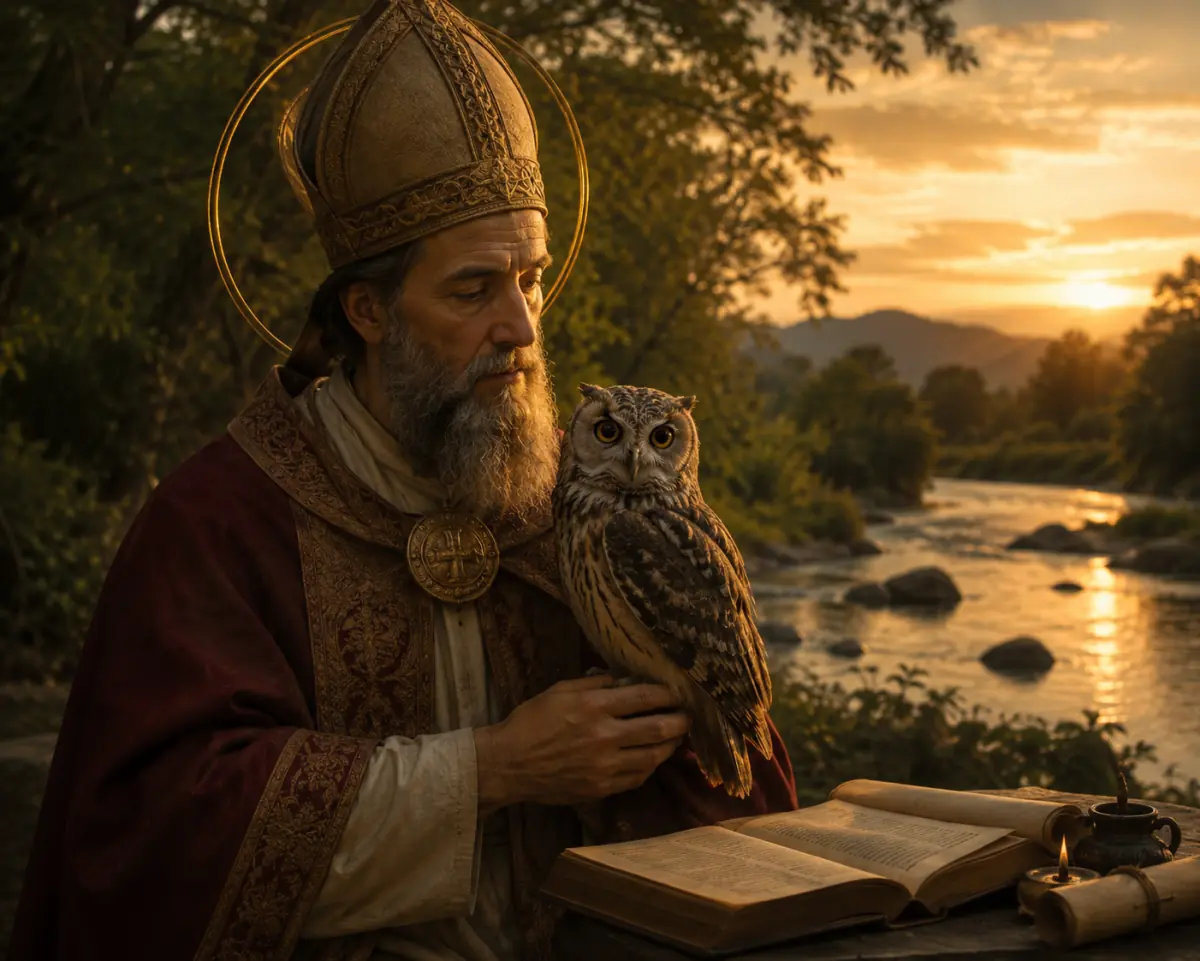
August 28 — Feast of St. Augustine
There is something fitting about remembering St. Augustine today beside the quiet river.
Augustine was a man who spent much of his life searching. He searched through knowledge, ambition, pleasure, philosophy, relationships, and the many voices of the world. He was restless, curious, intelligent, and deeply human.
Yet his deepest discovery was not simply about finding more answers.
It was about learning where to look.
One of Augustine's most enduring reflections is:
“Our hearts are restless until they rest in You.”
These words speak not only about faith. They speak about the human condition.
We are often restless because we are constantly looking outward. We seek the next achievement, the next experience, the next opportunity, the next answer. We fill our days with movement because we are afraid of what we might encounter in stillness.
But Augustine's life reminds us that there comes a time when the search must become quieter.
The heart must learn to listen.
And this is where the owl comes to mind.
The Owl Knows How to Be Silent
The owl is not a creature that needs to announce itself.
It watches.
It listens.
It waits.
In the darkness, where many things become difficult to see, the owl remains attentive. Its strength is not in constant movement. Its strength is in awareness.
There is something deeply philosophical about this.
The owl teaches us that silence is not the absence of activity. Silence is a form of attention.
To be silent is not necessarily to do nothing.
It can mean becoming present enough to notice.
- The movement of the leaves.
- The sound of water.
- The direction of the wind.
- The presence of another person.
- The thoughts within ourselves.
And perhaps, most importantly, the quiet voice of God.
In a noisy world, silence becomes a discipline.
We are surrounded by things competing for our attention. Messages arrive constantly. Information never seems to end. There is always something to watch, something to read, something to respond to, something to accomplish.
Yet the more noise we consume, the more difficult it can become to recognize what is truly important.
The owl offers another way.
It does not respond to every sound.
It observes.
It discerns.
It waits.
Then it moves with precision.
Keenness Comes From Stillness
We often think that being sharp means moving quickly.
But the owl suggests another definition.
Perhaps keenness comes from stillness.
When we are constantly moving, we can become reactive. We respond before understanding. We speak before listening. We act before seeing clearly.
Stillness creates space between what happens and how we respond.
That space is where discernment begins.
The owl sits quietly, but it is not unaware.
It is deeply aware.
Its silence sharpens its senses.
Its patience strengthens its response.
Its stillness prepares it for movement.
This is a wisdom that we can carry into our own lives.
You do not always need to move faster. Sometimes you need to see better.
Augustine and the Restless Heart
St. Augustine understood something about this restlessness.
His story was not a straight path toward peace. He experienced uncertainty, desire, ambition, intellectual struggle, and the search for meaning.
He wanted to understand.
He wanted to experience.
He wanted to find truth.
And eventually, his search led him toward a deeper realization.
The human heart can search endlessly for things that cannot ultimately satisfy it.
We can accumulate knowledge and still remain restless.
We can achieve success and still remain restless.
We can surround ourselves with people and still feel alone.
We can keep ourselves busy and still feel that something is missing.
Augustine's famous reflection points toward a different kind of fulfillment.
“Our hearts are restless until they rest in You.”
Perhaps the lesson is not that searching is wrong.
The search itself can be sacred.
But we need to know what we are ultimately searching for.
The Owl and the Inner Life
This is where the owl becomes more than a symbol of wisdom.
The owl can represent the inner life.
The part of us that watches quietly.
The part that notices what is happening beneath the surface.
The part that does not immediately react.
The part that asks deeper questions.
- Who am I becoming?
- What am I pursuing?
- Why am I so restless?
- What am I afraid to be still with?
- What truly gives my life meaning?
- What am I listening to?
And perhaps the most important question:
Where is my heart trying to rest?
These questions cannot always be answered through more information.
Sometimes they require silence.
The River Does Not Hurry
Beside Bukaw is the Malogo River.
The river gives us another image of this philosophy.
The river does not have a calendar on its banks.
It does not measure its worth by how much it accomplished today.
It does not panic when it moves slowly.
It does not become frustrated when a stone interrupts its path.
It simply continues.
Sometimes fast.
Sometimes slow.
Sometimes deep.
Sometimes shallow.
But always moving.
The river teaches us about flow.
The owl teaches us about awareness.
Augustine teaches us about rest.
Together, they offer a different understanding of a meaningful life.
- See clearly.
- Flow naturally.
- Rest deeply.
Productivity Without Restlessness
We often define productivity by visible movement.
- How many things did we finish?
- How many hours did we work?
- How much did we produce?
- How quickly did we respond?
But nature gives us another definition.
The river is productive without being hurried.
The tree grows without announcing its progress.
The owl watches without appearing busy.
There is a kind of productivity that happens quietly.
- Thinking is productive.
- Listening is productive.
- Resting is productive.
- Praying is productive.
- Observing is productive.
- Becoming is productive.
Not everything valuable can be measured immediately.
Perhaps this is one of the things we can learn from Augustine.
The inner transformation of a person may not look productive from the outside.
But it can change everything.
The Wisdom to Wait
The owl waits for the right moment.
The river waits for no one, yet it never needs to hurry.
Augustine spent years searching before his understanding became clear.
There is wisdom in this kind of patience.
We often want clarity immediately.
We want to know what comes next.
We want certainty before we move.
But life rarely works that way.
Sometimes clarity comes only after we have learned to sit with uncertainty.
Sometimes the answer comes after the question has lived within us for a while.
Sometimes God speaks most clearly when we finally become quiet enough to listen.
The owl understands the value of waiting.
Not passive waiting.
Attentive waiting.
The kind of waiting where the senses become sharper and the mind becomes quieter.
Bukaw
Perhaps this is what Bukaw can represent.
Not simply a place beside a river.
Not simply an owl.
Not simply a farm, a retreat, or a destination.
But a philosophy of living.
A place where we remember how to pay attention.
Where silence is not uncomfortable.
Where nature is not merely scenery.
Where the river reminds us that life can flow without being forced.
Where the owl reminds us that wisdom begins with seeing.
Where Augustine reminds us that beneath all our searching is a heart longing for rest.
Bukaw can be a space for returning.
- Returning to nature.
- Returning to stillness.
- Returning to meaningful conversations.
- Returning to ourselves.
- Returning to God.
A Quiet Invitation
Today, on the feast of St. Augustine, perhaps we do not need to make a grand resolution.
Perhaps we simply need to become a little quieter.
To sit beside the river.
To watch the water.
To listen to the trees.
To notice the things we usually overlook.
To allow ourselves to stop performing.
To stop rushing.
To stop trying to control every outcome.
And to ask the quiet questions.
- What is my heart really seeking?
- What has been making me restless?
- What deserves my attention?
- What can I finally let go of?
- Where can I find rest?
The owl watches from the trees.
The Malogo River continues its journey below.
And Augustine's words remain with us:
“Our hearts are restless until they rest in You.”
Perhaps wisdom begins when we stop trying to silence the world and start becoming silent ourselves.
Perhaps keenness comes when we learn to observe before we react.
Perhaps peace comes when we stop forcing the river to move according to our timetable.
And perhaps life becomes clearer when we understand that we were never meant to control everything.
We were meant to see.
We were meant to flow.
We were meant to become.
And, eventually, we were meant to rest.
The owl teaches us to see.
The river teaches us to flow.
Augustine teaches us to return.
And in the quiet space between them, perhaps we find what we have been searching for all along.