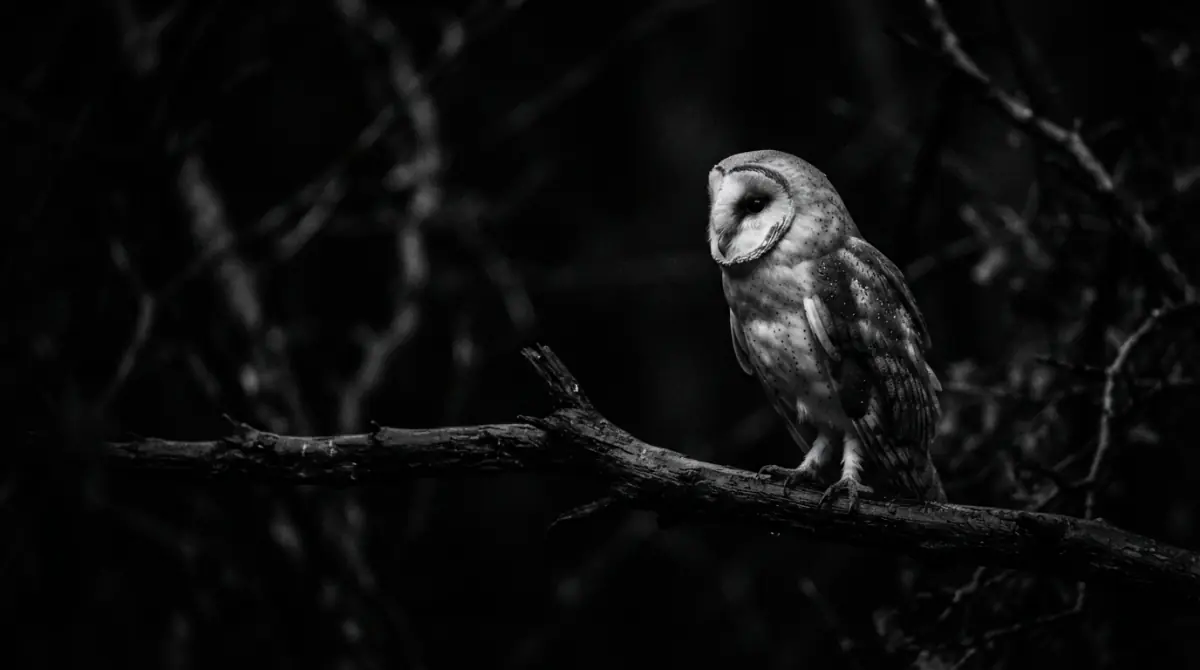
There is something about an owl that captures our imagination.
It can sit quietly on a branch for hours, almost completely still, watching the world move beneath it. Then, without warning, it spreads its wings and disappears into the darkness with barely a sound.
For centuries, owls have fascinated people across cultures. They have been associated with wisdom, mystery, intuition, protection, and even the unknown. But beyond the symbolism, the owl itself is an extraordinary creature—highly adapted to survive, hunt, and thrive in the darkness.
The Silent Hunter
Owls are among nature's most remarkable nocturnal hunters.
Their large eyes allow them to gather as much light as possible, helping them see in extremely low-light conditions. Unlike humans, however, owls cannot move their eyes freely from side to side. Instead, they can rotate their heads significantly, allowing them to survey their surroundings without moving their bodies.
Their hearing is equally impressive.
Many owl species have asymmetrically positioned ears, allowing them to determine where a sound is coming from with remarkable accuracy. In complete darkness, an owl can use sound to locate prey hidden beneath leaves, grass, or even snow.
And then there are their wings.
The specialized structure of an owl's feathers helps reduce the noise produced during flight. This allows the owl to approach prey almost silently—an incredible advantage for a predator that depends on surprise.
The owl doesn't need to chase the night.
It belongs to it.
Why Are Owls Associated With Wisdom?
The image of the wise owl has existed for thousands of years.
In ancient Greek culture, the owl was associated with Athena, the goddess of wisdom and strategy. The owl became a symbol of knowledge, observation, and intellectual insight.
Perhaps the symbolism makes sense.
Owls are creatures of observation. They are patient. They do not constantly move or make noise. They watch.
And sometimes, wisdom begins with exactly that: learning to be still enough to see what others miss.
In a world filled with constant notifications, conversations, opinions, and distractions, the owl represents another way of being.
Observe first.
Move when necessary.
Speak when there is something worth saying.
The Owl as a Symbol of the Unknown
Owls are creatures of the night, and humans have always been fascinated by darkness.
Night represents what we cannot immediately see or understand. It is the space between certainty and mystery.
Because owls move comfortably through this environment, many cultures have developed stories and beliefs around them. In some traditions, owls are viewed as protectors or messengers. In others, they have been associated with death, omens, or the supernatural.
These interpretations may differ, but they share something in common:
The owl represents what exists beyond ordinary sight.
It reminds us that just because something cannot be seen clearly does not mean it isn't there.
What We Can Learn From the Owl
Perhaps the most beautiful lesson of the owl is not about wisdom at all.
It is about presence.
The owl doesn't seem rushed.
It waits.
It listens.
It observes.
It trusts its senses.
And when the right moment arrives, it acts.
There is something deeply relevant about that in modern life.
We are constantly encouraged to move faster—to produce more, respond immediately, stay connected, and fill every quiet moment with something.
But nature operates differently.
The river flows without rushing.
The trees grow without announcing their progress.
And the owl waits in silence until it is time to move.
Maybe we need more of that.
The Owl and the Art of Seeing Clearly
An owl's world is different from ours.
Where we may see darkness, the owl sees opportunity. Where we may hear silence, the owl hears movement.
This is a powerful metaphor for life.
Sometimes the problem isn't that there is nothing in front of us.
Sometimes we simply haven't learned how to see it yet.
Clarity often comes from changing the way we observe.
Stepping away from noise.
Spending time in nature.
Allowing ourselves to become quiet.
Giving our minds enough space to notice what has been there all along.
The owl teaches us that seeing clearly doesn't always require more information.
Sometimes it requires less noise.
A Quiet Symbol for a Noisy World
The owl remains one of nature's most fascinating creatures because it carries both mystery and meaning.
It is powerful without being loud.
Alert without being restless.
Independent without being disconnected.
And patient without being passive.
Perhaps that is why the owl continues to appear in stories, art, mythology, and modern culture.
It represents something many of us are searching for:
Wisdom to know what matters. Stillness to observe. Courage to move through the darkness. And clarity to know when it is time to fly.
The owl doesn't need to conquer the night.
It simply knows how to move through it.
And perhaps that is a lesson worth remembering.