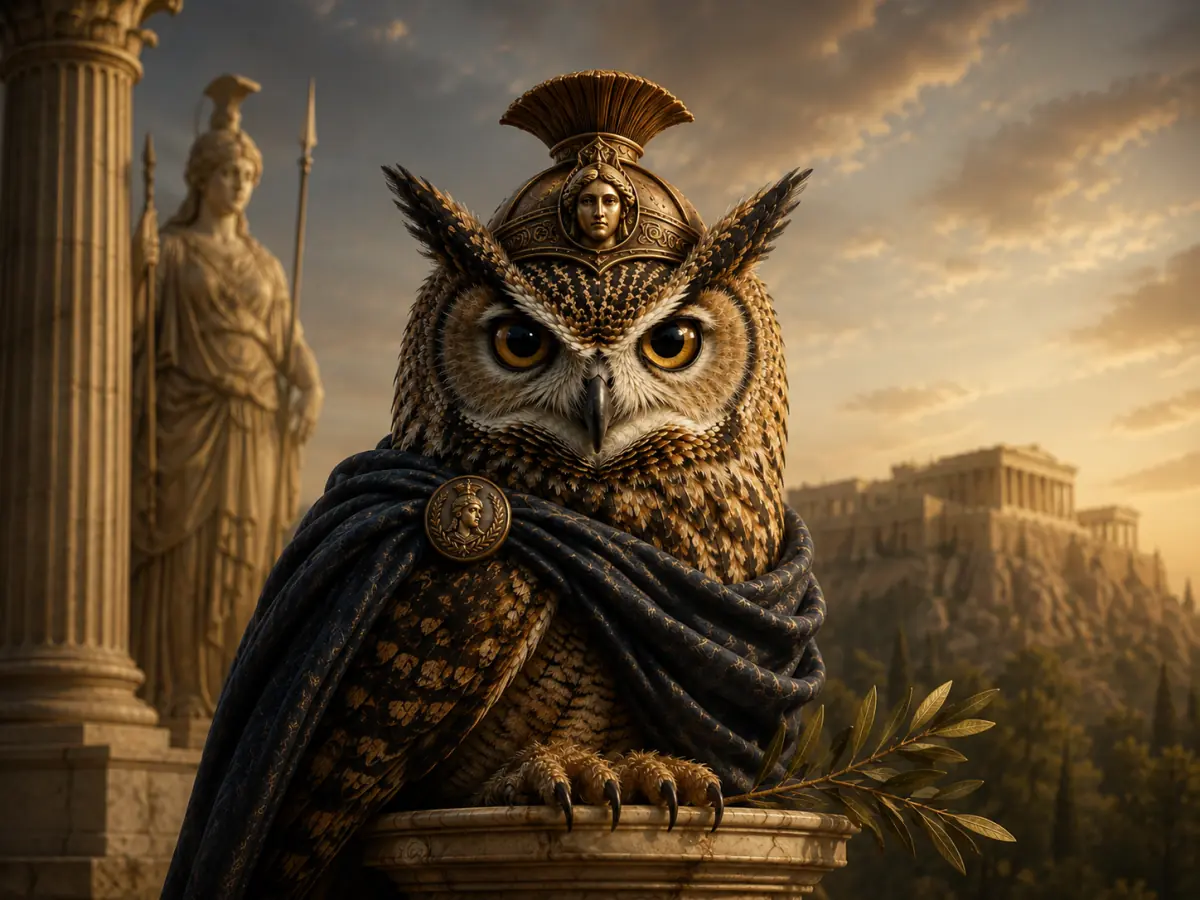
On why you can't understand a season of your life until you've stopped moving through it
There is a line at the end of the preface to Hegel's Philosophy of Right, written in 1820, that has outlived almost everything else in the book:
Die Eule der Minerva beginnt erst mit der einbrechenden Dämmerung ihren Flug.
The owl of Minerva takes flight only as the dusk comes in.
Minerva is the Roman Athena — wisdom, strategy, the clear-eyed kind of intelligence. The owl is her companion, the bird that sits on her shoulder in the old statues. And Hegel's point, in context, is faintly deflating. He was talking about philosophy, and about its embarrassing lateness. Thought arrives after the fact. By the time we can explain a world clearly enough to write it down, that world has already finished happening. Philosophy doesn't tell the age how to be. It shows up at closing time and describes what the age was.
He meant it about epochs. Empires, moral orders, whole centuries of assumption. It's an unfair thing to shrink down to the size of one human life.
But the shape of it holds. Anyone who has come out the far side of a hard year knows the shape of it exactly.
You cannot narrate a season while you are inside it
Ask someone in the middle of a bad stretch what's happening to them and they will give you logistics. The deadline moved. The client went quiet. There's a thing with my sister. I haven't been sleeping well but that's normal for me. It's fine, it's just a lot right now.
None of that is a lie. It just isn't the story yet.
The story is what you get a year later, when you say — oh, that was the year I stopped calling anyone back. Or: that was when the work stopped being mine and became something I was just servicing. Or, most common and most quietly devastating: I didn't know I was unhappy. I thought I was busy.
That sentence is the owl. It only becomes available to you afterward.
Partly this is just how meaning works. A season needs an edge before it can have a shape, and you can't see the edge from inside. But there's a harder reason too, and it's less flattering. In the middle of it, you were too occupied to look. Not unwilling — occupied. Attention is finite and yours was fully spent on the next thing, and then the next. Reflection isn't a mood. It's a resource, and you had none of it.
Dusk, not night
The metaphor has a detail people skip past, and it's the one that matters most.
The owl flies at dusk. Not at noon, when there's too much light and too much noise and every other creature is out competing for the same air. And not at midnight either, in full dark, in collapse.
Dusk is a narrow window. It's the part of the day when the work is finished but you are still awake. When the light has softened enough that you're no longer squinting, but not gone entirely.
Most burnt-out people do not get dusk. They go straight from noon to blackout. They run at full brightness until the body files an objection — the illness, the panic in the parking lot, the flat inability to open the laptop one more morning — and then they crash into a dark so complete that nothing can be seen in it either. Collapse is not reflection. You don't learn anything in the dark. You just stop.
What Hegel's owl needs is the in-between. Enough rest to have stopped, enough presence to still be looking.
That window has to be entered deliberately, because nothing in an ordinary life produces it on its own. Nobody schedules dusk. It has to be taken.
Why an owl, specifically
Here is the part the Greeks couldn't have known and that makes the symbol better than they intended.
An owl hunts almost entirely by ear. The dish of its face works as a parabolic collector, funneling sound inward. In several species the ear openings sit at different heights on the skull, so a sound arrives at one a fraction of an instant before the other — and from that infinitesimal gap the bird computes elevation as well as direction. It can locate a mouse under snow. In total darkness. From the sound alone.
And it can only do this because it is silent. The leading edges of an owl's flight feathers are combed into a soft fringe that breaks up the turbulence of the wingbeat. It flies without making the sound of flying.
That isn't decoration. It's the precondition. The owl's hearing is so fine that its own noise would drown out the world. If it flew like other birds, it would be deaf to everything it needs.
Sit with that for a second, because it is the whole thing.
You are not going to hear your life over the sound of yourself moving through it.
The signal is small. It was always small. It's a slight dread on Sunday evenings. A friendship you have let go quiet. The fact that you have started describing your own work in the passive voice. These are mouse-under-snow signals — real, locatable, but only by someone who has stopped generating noise.
The honest part
I want to be careful here, because this is exactly the point where writing like this usually starts making promises.
Rest does not manufacture insight. There is no arrangement of hammock, coastline and unstructured afternoon that will hand you the meaning of your last two years. Plenty of people stop and find only that they are tired, and then that they are bored, and then that they are restless and would like to check their email. Stillness is not a vending machine.
What stillness does is more modest and harder to sell. It removes the obstruction. It creates the conditions under which understanding becomes possible — the dusk window, the silent flight — and then it waits, with no guarantee.
Hegel's version has the same austerity, which is why the line has teeth. He isn't promising that wisdom arrives in time to save you. He is saying the opposite: it comes late, it comes after, and it doesn't spare you the season. The consolation on offer is not rescue. It's comprehension. You get to know what happened to you.
That is genuinely less than we want. It is also not nothing. Understanding a season is how you stop unconsciously reconstructing it. The person who can finally say that was the year I disappeared into the work is, for the first time, someone who could notice it starting again.
Late is not the same as too late
The uncomfortable implication of the owl is that you have already lost the season. It's over. Whatever you learn about it, you learn as a survivor, not as someone who steered.
But the seasons keep coming. And a person who has looked back at one clearly enough to name it carries something into the next one that they didn't have before — not foresight, exactly. Recognition. The capacity to catch the shape earlier the second time, because they've seen the shape.
The owl flies at dusk. It cannot fly at dawn; that isn't what it's for. But the flight is not a lament. It's a bird going out, in the quiet, to find something real.
The only requirement is that you stop long enough to let the noise die down.
And that you're still awake when it does.